

By Matt Bigler, Attorney — Former Marion County Prosecutor, Fatal Alcohol Crash Team (FACT) Unit
Before joining LFB in 2016, I was the prosecutor for the Fatal Alcohol Crash Team (FACT) at the Marion County Prosecutor’s Office. As the only attorney prosecuting these cases while I was in that role, my job was to be the go-to prosecutor resource for the DUI and Hit and Run investigators for serious injury and fatal crashes.
I’ve noticed lots of hit & run stories in the local news lately, so I called a detective friend at IMPD and asked what the numbers actually look like. Here’s what he sent me:
Hit & Run Crashes in Marion County: The Numbers
| Year | Fatal Crashes | Serious Bodily Injuries | Personal Injuries | Property Damage |
| 2023 | 16 | 15 | 651 | 6,429 |
| 2024 | 28 | 20 | 638 | 6,538 |
| 2025 | 13 | 22 | 572 | 6,023 |
| 2026 (est.) | 8 | 19 | 541 | 4,835 |
Source: IMPD. 2026 estimate includes data up to August 21 and multiplied by 1.3333 to estimate year end numbers. Figures cover IMPD and Marion County only and do not include Lawrence PD or Indiana State Police, so the true countywide total is higher.
Hundreds of people are hurt in Marion County every year by drivers who don’t stop, and dozens are hurt critically or even fatally.
Can You Still Make a Claim If the Driver Never Stopped?
Since moving on to helping injured people at LFB, I’ve represented multiple hit and run victims in claims for compensation. Victims of hit and run crashes often wonder whether they can make an insurance claim at all if they don’t know who hit them. Fortunately, the answer is often yes. Many auto insurance policies include provisions under their uninsured motorist (UM) coverage that apply specifically to this situation, when the at-fault driver can’t be identified.
Why UM insurance matters: About 1 in 7 drivers in Indiana are uninsured, and many more carry only the state minimum of $25,000 in liability coverage. This doesn’t go very far if your injuries are more than superficial. Carrying enough UM/UIM coverage (we typically recommend at least $250,000) is often the difference between recovering something after a hit & run and being financially ruined if hurt by an irresponsible party.
What This Looks Like in an Actual Policy
See below for a common example of the language used in an actual insurance policy.
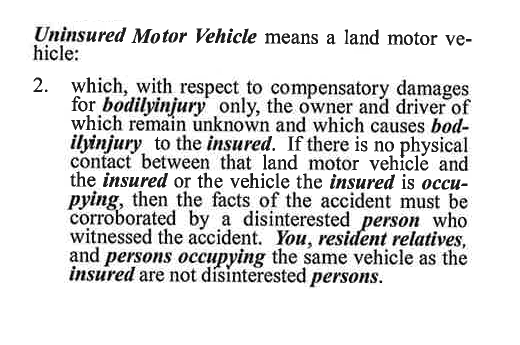
The critical thing to notice when you read that excerpt, is that sometimes, if there is no contact between the vehicles, it takes some luck by the insured in being able to identify a disinterested witness. For example…
The Catch With No-Contact Hit & Runs
Say you’re driving down a two-lane road and an oncoming vehicle suddenly swerves into your lane. You steer into a ditch to avoid a head-on collision, and the other driver keeps going. You were the victim of another driver’s negligence, but the insurance company isn’t going to take your word for it. If they did, anyone could drive into a ditch on their own and claim a phantom vehicle caused it.
To successfully make a claim in this kind of no-contact scenario, you generally need a disinterested witness — someone with no stake in the outcome — who can confirm what happened. That’s the single biggest thing people don’t realize until they’re already in this situation.
Common Questions About Hit & Run Claims in Indiana
Is a hit and run a felony in Indiana?
Yes, a hit and run can be a felony in Indiana, depending on the severity of the crash. Indiana’s leaving-the-scene statute (IC 9-26-1) has different levels depending on whether the crash involved only property damage, injury, or death.
Does insurance cover a hit and run if they never catch the driver?
The answer is usually yes, IF you have uninsured motorist coverage and can meet your policy’s requirements (including the witness requirement for no-contact cases described above). This is exactly why we recommend carrying UM/UIM limits well above the state minimum.
What should I do immediately after a hit and run?
The first 72 hours after an accident are crucial when it comes to preserving evidence. If you’ve been in an accident, try to follow these steps:
- Seek medical attention immediately. Your health should be your #1 concern before anything else. Keep all medical records for use in the claim.
- Take pictures of the accident scene and gather contact information from any eyewitnesses.
- Call the police to file a report.
- Contact a personal injury attorney as soon as you can. They can help you make sure you’re building a strong case and collecting the information you need.
- Do not give any statements to the insurance company. What you say will most likely be used against you.
If You’ve Been Hit and the Driver Didn’t Stop
If you’ve been injured in a hit & run crash, call the attorneys at LFB. We can help you sort through the legal and contractual hurdles standing between you and a claim, and get you moving toward recovery instead of stuck arguing with an insurance company.
Be safe out there.
— Matt Bigler